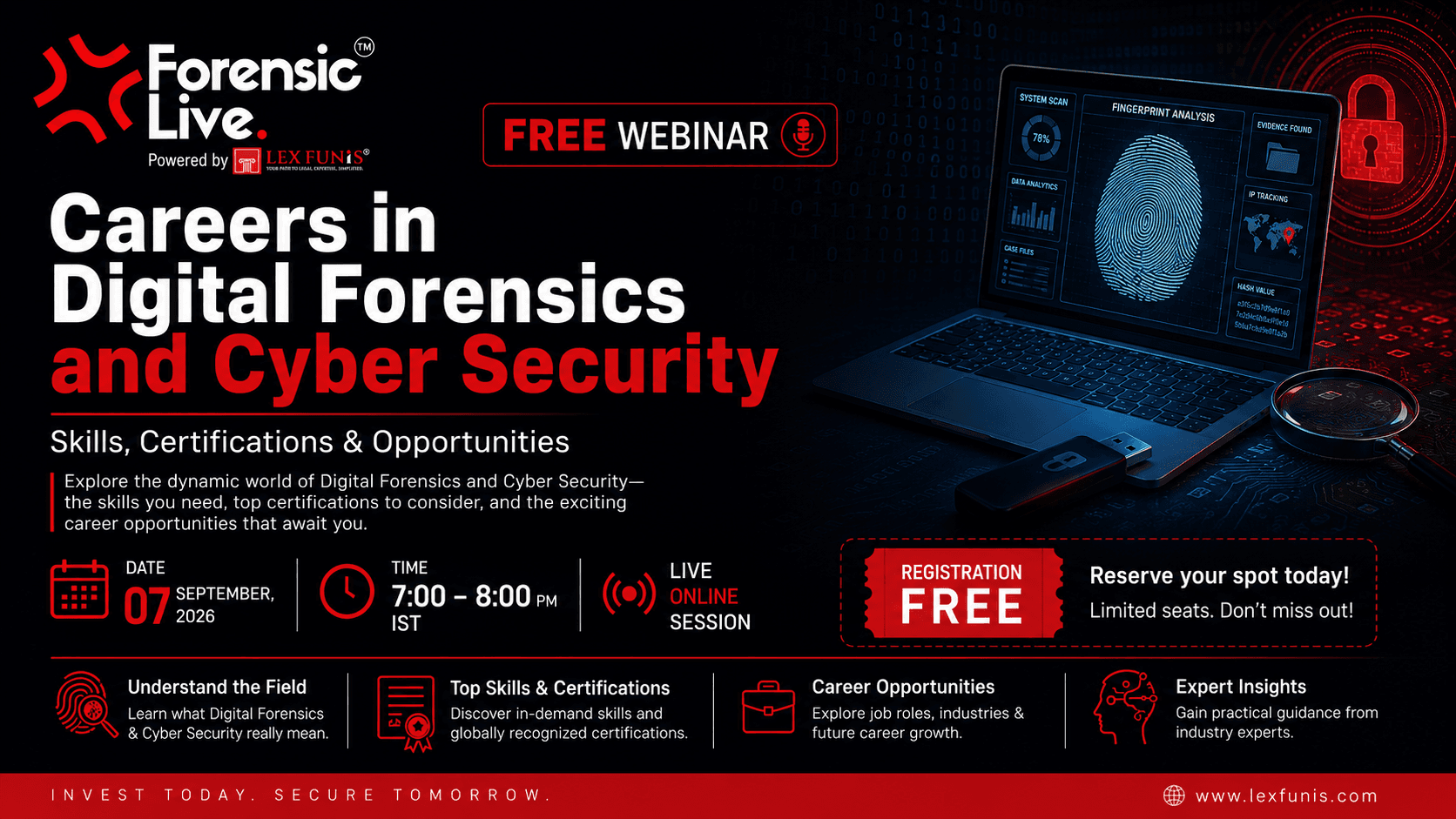
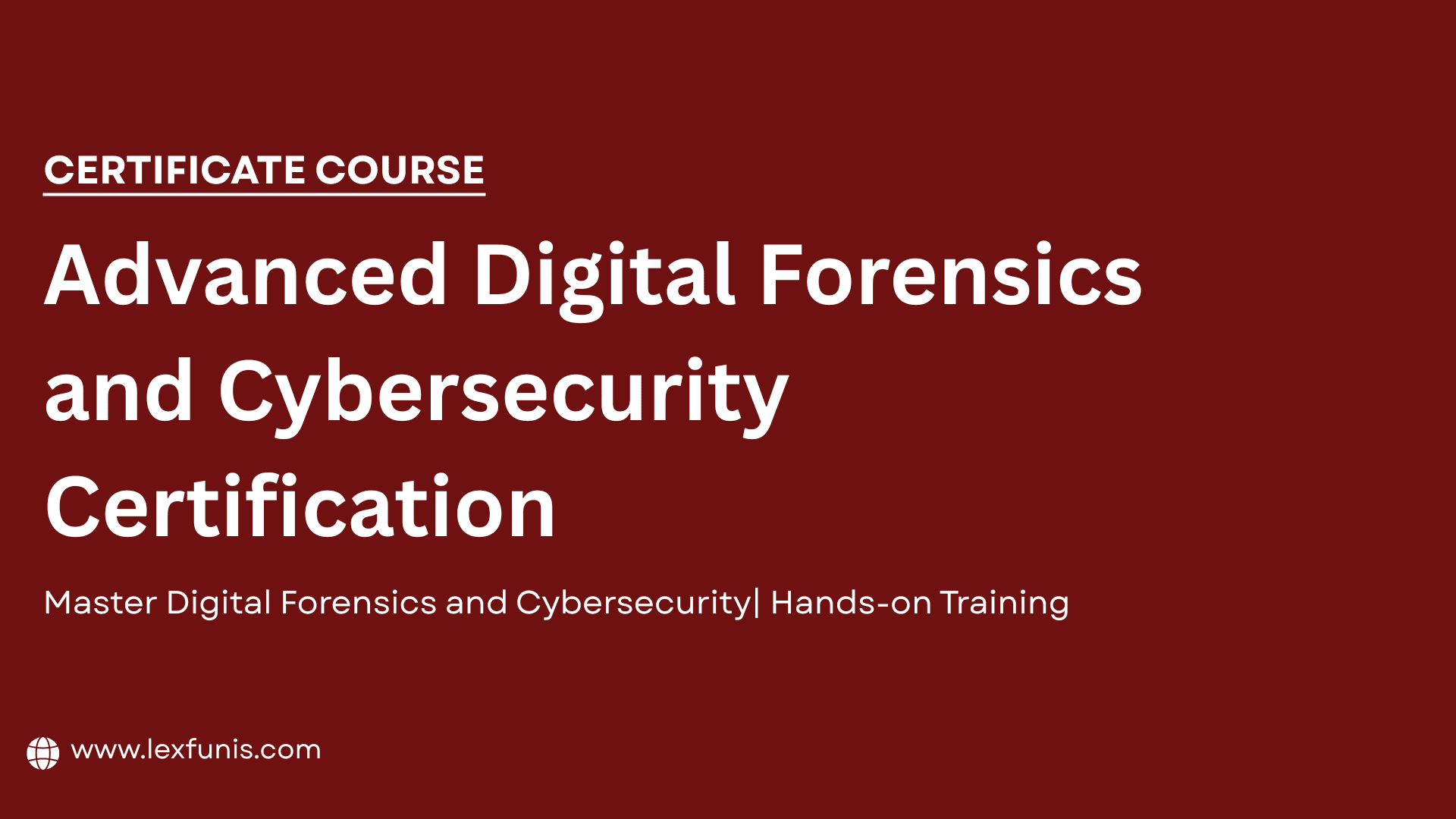
Advanced Digital Forensics & Cybersecurity Certification
Hands-On Training in Digital Forensics & Cybercrime Investigation — Limited Seats, First Come First Serve
Mr. Sama Anudeep
Assistant Professor
Parul University
Mr. Osayomore Aigbogun
Doctoral Candidate, Digital Forensics and Cybersecurity
Sam Houston State University, United States
Mr. Abhishek Waghmare
Founder
Cyber Chakra Technology · IIT Kanpur
Ms. Pamela Kirui
Teaching Assistant, Digital Forensics and Cybersecurity
Sam Houston State University, United States
Date
1–31 October 2026
Time
Monday to Friday · 7:00 – 8:00 PM IST
Mode
Online
Duration
1 Month
About this course
Master digital forensics, cybercrime investigation, and cybersecurity fundamentals in this intensive month-long certification. Learn the IT Act 2000, electronic evidence admissibility under Section 65B, cryptography, incident response, and OSINT through hands-on labs with industry-standard tools — and gain the skills to investigate cybercrimes and present digital evidence that meets Indian court standards. Designed for law students, forensic professionals, cybersecurity practitioners, and law enforcement, it culminates in a verifiable digital certificate.
Highlights
What you'll learn
Learning Outcomes
Curriculum
Week 1 · Foundations of Cybersecurity & Cyber Crime (Oct 1–6)
- Introduction to cybersecurity: domains, career roles, and the global threat landscape
- Cyber crime & digital forensics: attack types, threat actors, and evidence preservation principles
- Case study — anatomy of famous data breaches (Equifax, Target, Yahoo) and defensive failures
- IT Act 2000: Sections 43, 65, 66, 67, 67B — penalties, prosecution, and 2023 law updates
Week 2 · Legal Frameworks & Incident Response (Oct 7–14)
- Indian Evidence Act Section 65B: electronic evidence admissibility, chain of custody, and court standards
- Case study — landmark Indian cybercrime convictions and forensic expert testimony
- Defense mechanisms: firewalls, antivirus, IDS/IPS, patching, and backup strategies
- Security policies & compliance: ISO 27001, password policies, MFA, and audit procedures
- Case study — ransomware attack walkthrough: anatomy, containment, and recovery
- Incident reporting & first response: classification, escalation, and evidence preservation
Week 3 · Information Security & Cryptography (Oct 15–21)
- Information security fundamentals: CIA Triad, AAA model, risk assessment, and access control
- Cryptography I: symmetric encryption (AES), asymmetric encryption (RSA), and key management
- Cryptography II hands-on lab: OpenSSL and GPG file encryption, digital signatures, secure transmission
- Hashing: MD5, SHA-1, SHA-256 — integrity verification and forensic applications
Week 3–4 · Networking & Cyber Attacks (Oct 22–28)
- Computer networks: OSI & TCP/IP models, LAN/WAN, and common ports (HTTP, HTTPS, SSH, SMTP, DNS)
- IP addressing deep dive: IPv4 classes, subnetting, CIDR, DHCP, MAC addresses, and ARP
- Networking tools lab: ipconfig, ping, tracert, WHOIS, nslookup, and IP tracing exercises
- Attacks I: phishing, social engineering, DoS/DDoS, and MITM — with a live phishing demonstration
- Attacks II: brute-force and dictionary attacks, rainbow tables, and a John the Ripper demo
Week 4 · OSINT, Digital Forensics & Capstone (Oct 29–31)
- Google Dorking & OSINT: search operators, footprinting, ethical limits, and law-enforcement applications
- Digital forensics: evidence types, timeline reconstruction, log analysis, mobile and cloud forensics
- Capstone mini-challenge: solve a full cybercrime investigation — evidence analysis, report writing, and peer review
Speakers
Mr. Sama Anudeep
Assistant Professor
Parul University
Educator and researcher specializing in cybersecurity and digital forensics, with expertise spanning information security, incident response, and forensic investigation methodologies.
Mr. Osayomore Aigbogun
Doctoral Candidate, Digital Forensics and Cybersecurity
Sam Houston State University, United States
Leading doctoral researcher in digital and cyber forensics focused on advanced investigative techniques, international cybercrime cases, and forensic evidence collection and preservation.
Mr. Abhishek Waghmare
Founder
Cyber Chakra Technology · IIT Kanpur
Ms. Pamela Kirui
Teaching Assistant, Digital Forensics and Cybersecurity
Sam Houston State University, United States